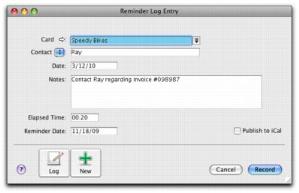
The reminder log enables you to keep a detailed log of all the phone calls you and your contacts make to each other, and any other type of correspondence.
For example, let’s say that you call customer A regarding an overdue invoice. You could create a log entry that records the date of the phone call, a summary of the outcome, and the date you will want to recontact them by if their invoice is still outstanding.
When a customer or supplier calls, you can use the reminder log to retrieve a complete history of your business relationship with that contact.
Note that you can also automatically create reminder log entries for each sale, purchase, payment and receipt you record.
If you use iCal to plan your day-to-day activities, you can publish reminders in iCal. This enables you to keep all reminders in one application. For more information, see
Publishing to iCal.
|
|
|
|
|
|
|
Enter the name of the person that is associated with this entry. For example, you can enter the name of the person you spoke to on the phone.
If you have specified a contact person in the contact’s card, you can click the down-arrow to choose that person.
|
|
|
Enter the date you spoke or wrote to the contact. If you are simply entering an appointment or reminder, you can enter today’s date.
|
|
|
|
|
|
If you want to record the time you spend speaking to the contact, or working on a particular task related to the entry, enter the time in hours and minutes. For example, if you spend 15 minutes, enter 15. If you spend 1 hour and 15 minutes, enter 1:15.
|
|
|
If you want to be reminded to follow up the contact, enter the date you want to be reminded to recontact them. The reminder will appear in the Contact Alert tab of the To Do List on this date. For more information, see To view reminders.
|
|
|
View all reminder log entries for the selected contact.
|
|
|
Select this option if you want to add a To Do entry in the iCal To Do panel for this log.
Note that if you do not enter a date in the Reminder Date field, the To Do entry will appear in iCal on the date in the Date field.
|
|
|
|
You can choose to automatically create log entries each time you record a sale, purchase or banking transaction. The log entry contains basic information about the transaction, such as the invoice number, cheque number and the amount.
If you record many transactions and choose to automatically create log entries for them, the size of your company file may increase significantly. If the company file size becomes an issue, you can purge old log entries and other data. For more information about purging information, see
Purging information that is no longer needed.